Context
By 2024, the Luini brand had proven itself. Two locations — San Pedro de Alcántara and Hotel El Fuerte in Marbella — were operating consistently. The group had a brand chef in Oleksii Dolbniev, a kitchen team that functioned well, and a defined operational model.
The natural next move would have been a third Luini. Same concept, new location, lower risk, faster execution. That was not the move that was made.
Nikolay Nikitenkov had been thinking about a different kind of restaurant for some time — one built around fire cooking rather than Italian technique, drawing on a different set of culinary traditions, and positioned in a different market segment. Luini had demonstrated that the group could execute at a high level. Luidze was the project that would test whether the group could build something genuinely new.
The decision was made to develop a second brand with its own identity, its own location, and its own DNA.
The Challenge
Creating a restaurant concept on the Costa del Sol that is genuinely differentiated — not just another grill, not a fusion concept in the vague sense, but something with a clear culinary logic and a specific audience.
The Costa del Sol has no shortage of restaurants. It has steakhouses, Mediterranean grills, and beachfront fish restaurants in abundance. Standing out in that environment requires more than a good fit-out and a well-photographed menu. It requires a concept with an actual point of view — one that a guest could describe to someone else in one sentence and that delivers on what that sentence promises.
The specific challenges:
- Define a concept that is distinct from Luini without contradicting it
- Find a location that suits a destination-dining model rather than high-footfall convenience
- Install a professional open-fire grill system — a 2.5-meter installation — in a space designed for it
- Develop a menu that integrates fire cooking, Georgian culinary tradition, and Mediterranean ingredients coherently
- Build an audience in Estepona, which has less hospitality infrastructure than central Marbella
What Was Done
Concept selection: fire, Georgian accents, Mediterranean base
The Luidze concept was built from three components that had not previously appeared together on the Costa del Sol.
Fire cooking as the primary method — not as an option on the menu but as the organizing principle of the kitchen. Every dish would be shaped by what fire does to ingredients: the char, the rendering, the particular chemistry of open-flame heat.
Georgian culinary tradition as the accent layer. Georgian cuisine uses herb profiles, fermentation techniques, and slow-cooking approaches that are unfamiliar to most guests in southern Spain and that interact productively with fire cooking. Tarragon with slow-braised lamb, fermented dairy, sour counterpoints to charred proteins — these are not decorative additions. They are structural elements that distinguish the flavor profile of the menu from any other grill restaurant on the coast.
Mediterranean ingredients and atmosphere as the base. Local seafood, Spanish produce, the outdoor character of Andalusian hospitality. Luidze is not a Georgian restaurant transplanted to Spain. It is a Spanish restaurant shaped by Georgian technique.
The name Luidze — rendered also as Cortijo Luidze to signal the country estate character of the property — connects to the broader group identity while signaling a different kind of experience.
Location: Saladillo, Estepona
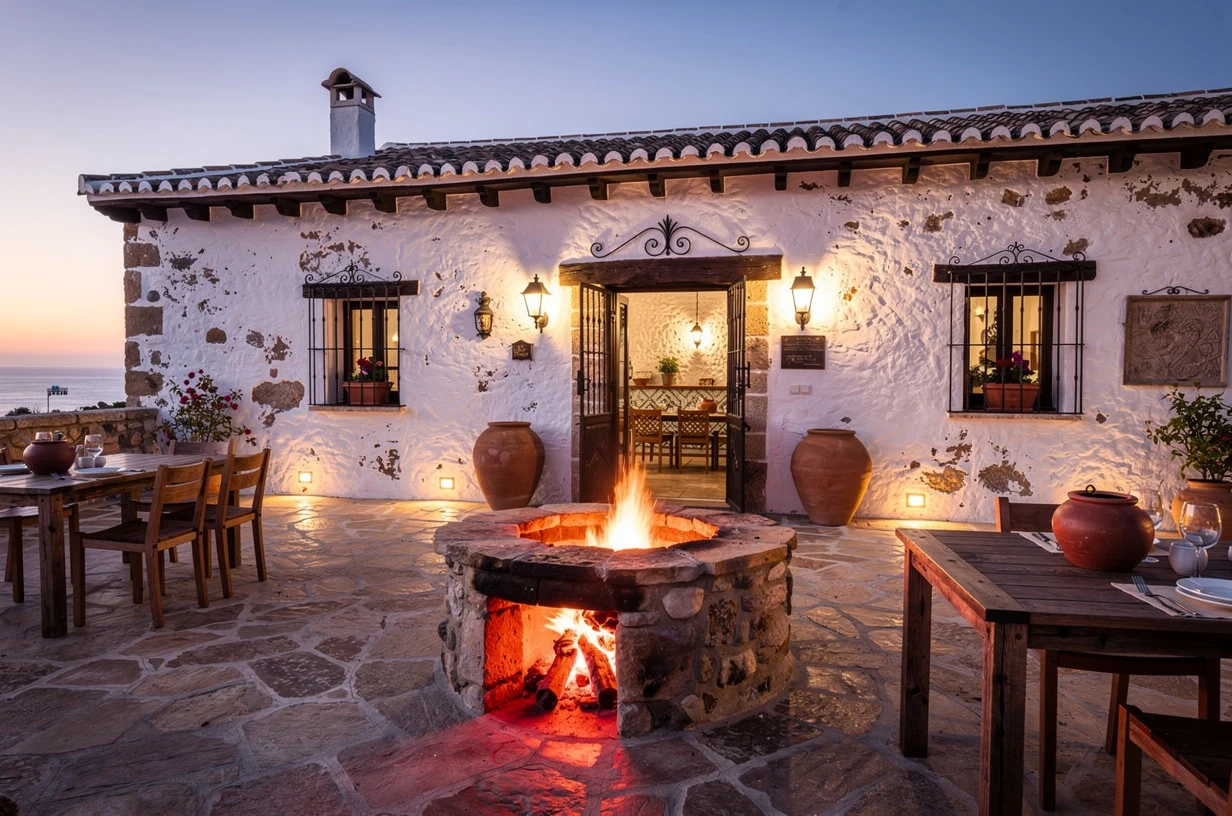
C. Saladillo, 100 in Estepona was selected after a deliberate search for a property type that Marbella and San Pedro couldn’t offer: space.
A 2.5-meter open grill requires a specific installation environment. A family concept with a children’s play area requires outdoor space. A destination restaurant — one that guests drive to intentionally rather than walk past — benefits from a site that has its own character rather than borrowing it from a busy street.
Estepona was also strategically appealing. The area has been growing — new residential development, an increasing number of families establishing permanent residence, less dependence on peak-season tourist volume than areas closer to central Marbella. A restaurant positioned for the family audience in a growing residential area has a different trajectory than a beach-season operation.
Installing the 2.5-meter open grill
The grill installation was a significant capital investment and the technical centerpiece of the project. The size was determined by the range of products the menu required — different proteins, different vegetables, different preparation stages — and by the need to manage multiple heat zones simultaneously during service.
The kitchen team, led by Oleksii Dolbniev, trained specifically on the open-fire format before opening. Fire cooking requires a different skill set than conventional kitchen work: heat management is dynamic and continuous rather than set-and-forget, and the relationship between product and flame requires close attention at every stage.
Menu development with Oleksii Dolbniev
The menu was developed collaboratively between Nikolay and Oleksii over a period of months, testing dishes that justified the grill as their cooking method — not dishes where the grill was incidental.
Sea bass in kataifi with beurre blanc. Kataifi (shredded pastry) wraps the fish before it goes to the fire, creating a crisping, protective layer. The beurre blanc provides a clean, acidic counterpoint to the char.
Slow-braised lamb with tarragon. A direct reference to Georgian technique: the lamb is cooked low and slow rather than at high heat, the tarragon worked into the braise rather than applied at the end. The result is a dish where the herb is structural rather than decorative.
Veal with sweet peppers. The peppers are cooked directly on the grill until caramelized. The sweetness they develop against fire is the dish’s center.
Fermented camembert. Served warm. The fermentation introduces sourness and complexity that fresh camembert lacks; the fire brings the cheese to a texture that reinforces its richness while the sourness cuts it.
Children’s play area as part of the concept
The play area was planned into the Luidze concept from the beginning. The family audience on the Costa del Sol represents a significant and poorly served segment of the market — families who want to eat well but need a space where children are genuinely welcome rather than merely tolerated.
Designing the play area as part of the concept, rather than as an amenity bolted on afterward, allowed it to be positioned and resourced appropriately. It is not a corner with a toy box. It is a dedicated outdoor space that allows adults to eat a full meal without managing children at the table throughout.
Opening: June 2025
The restaurant opened in June 2025. The timing was chosen to capture the beginning of the summer season while having the operation running before peak volume.
Results
- Operational: Cortijo Luidze opened on schedule in June 2025 and has been operating continuously since, serving the Estepona area and drawing destination guests from across the Costa del Sol
- Concept differentiation: Luidze is the only restaurant on the Costa del Sol operating at this format — open fire cooking at this scale, combined with Georgian culinary accents and a family-oriented concept
- Media coverage: Euro Weekly News covered the opening, providing regional English-language visibility to the international resident audience
- Chef recognition: Oleksii Dolbniev’s 2024 win in a televised chef competition against a Puerto Banús team — ahead of the Luidze opening — established the kitchen team’s credibility with a regional audience before the restaurant existed
- Group development: Luidze established the second major brand in the Nikitenkov restaurant group, demonstrating the group’s ability to develop and launch a genuinely new concept rather than replicate an existing one
Key Takeaways
Differentiation requires a specific point of view, not a general one. “A grill restaurant with Mediterranean influences” describes dozens of places on the Costa del Sol. “A fire grill restaurant using Georgian culinary technique on local Mediterranean ingredients” describes one place. The specificity is what creates the identity that guests can carry away and repeat to others.
Concept and location must reinforce each other. A destination-dining concept needs a space that supports destination behavior — room, character, something to see and experience beyond the plate. A high-footfall, city-center site would have given Luidze the wrong audience and the wrong atmosphere. The Saladillo location was chosen because it matched what the concept was, not because it was convenient.
Building concepts is a different skill than building operations. The Luini experience gave the group the operational platform to launch Luidze — supplier relationships, kitchen team, management structure. But developing the Luidze concept required a different kind of work: thinking through culinary identity, testing ideas before they became menu items, making decisions about what the restaurant would not be as much as what it would be. Both are necessary. Neither substitutes for the other.
Related Work
The launch of Luini San Pedro — which provided the operational foundation for everything that followed — is documented in the Luini San Pedro case study.
Work With Nikolay
If you are developing a new restaurant concept and want an experienced perspective on concept definition, location selection, or the launch process, Nikolay works with restaurateurs at this stage through his consulting practice.
