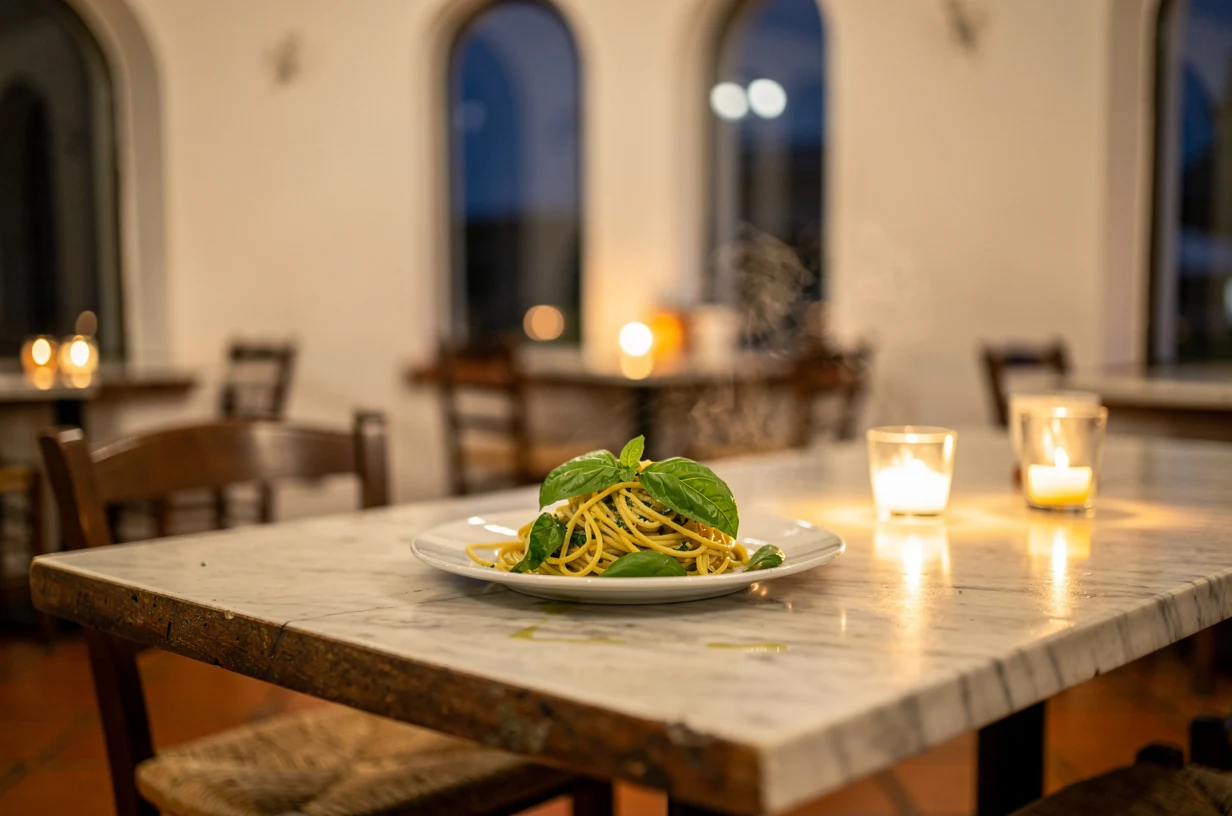
People ask why Italian. I trained at ALMA in Italy. I know Italian culinary logic from the inside. But the honest answer is more layered than credentials.
When I arrived in Spain in 2022, I was looking for a concept that I could execute at a high level, that the market here would recognize, and that gave me room to do something with real craft. Ukrainian cuisine — which I love and which runs through everything I do — was not the right first move on the Costa del Sol. Not because it isn’t worthy of a restaurant, but because introducing a cuisine to an audience that doesn’t know it requires a different kind of investment: in marketing, in explanation, in patience. I didn’t have unlimited runway for that.
Italian was different. The Costa del Sol has a large British and Northern European population that understands Italian food and has strong opinions about it. The tourist market responds well to it. And crucially, it is a cuisine where the gap between something done carelessly and something done with genuine attention is immediately visible to the guest. Handmade pasta looks different. It tastes different. If I was going to enter a market where Italian restaurants already existed, the quality argument had to be real, not just asserted.
The Luini concept
The word trattoria is important to how we think about Luini. It’s not a fine dining restaurant. It’s not fast-casual either. A trattoria is a place where you eat very good food in an environment that doesn’t make you feel like you need to dress up or lower your voice. The food is the point. The atmosphere supports the food rather than performing around it.
The pillars were simple: handmade pasta made fresh, a pizza that takes its dough seriously, and a seasonal chef’s menu that changes with what is actually available rather than running the same dishes year-round. Prices that make the restaurant accessible for a midweek dinner, not just a special occasion. Service that is warm without being performative.
This sounds like what every restaurant claims. The difference is in the execution, and execution is a day-by-day thing. You maintain it or you don’t.
San Pedro de Alcántara: why this location
San Pedro de Alcántara sits between Marbella and Estepona and gets overlooked by people who focus on Puerto Banús and the Marbella Golden Mile. That was partly why I chose it.
The neighborhood has a genuinely local character alongside its tourist traffic. There are families who live here year-round, a growing number of long-term foreign residents, and enough evening activity on Calle Andalucía to sustain a restaurant through the quieter months. We are at Calle Andalucía, 6 — a ground-floor location with good visibility, foot traffic from both directions, and enough surrounding hospitality to make the street itself a destination.
The rent was also more honest than anything closer to central Marbella, which gave us room in the early months to build the business without needing to be immediately at full capacity to cover costs.
Finding Oleksii Dolbniev
A restaurant concept is only as good as the person who can execute it in a kitchen every day. I needed a brand chef who understood Italian technique, had the curiosity to work with seasonal and local Spanish ingredients, and could lead a kitchen team with authority and clarity.
Oleksii Dolbniev arrived in my orbit through the wider Ukrainian hospitality community that had dispersed across Europe after 2022. He had worked in Odessa, which gave him a rigorous technical base. He had then worked in Norway — which sounds like an odd detour for someone who would end up cooking Italian in Spain, but Scandinavia has produced some of the most disciplined and thoughtful kitchen culture of the last two decades, and those habits travel.
The first conversation about the menu went for a long time. We talked about what pasta means when it’s made by hand that morning versus what it becomes when it sits. We talked about what seasonal actually means if you commit to it. We agreed on almost everything. That doesn’t always happen with people who cook at a high level and have strong views. When it does, you don’t negotiate it — you move.
Oleksii is now brand chef across the full group, and in 2024 he won a televised chef competition against a team from Puerto Banús. The result was satisfying in exactly the ways you’d expect.
The menu
Handmade pasta is the center of the Luini identity. We make it fresh. It’s on the plate within hours of being prepared. The difference in texture and flavor compared to dried pasta, done right, is not subtle.
The seasonal chef’s menu is the part that requires the most discipline. It forces us to actually track what’s in season, what the local suppliers have, and what we can build a coherent menu around in a given month. There are weeks when this is straightforward. There are weeks when the right ingredient doesn’t arrive and we have to adapt quickly. That pressure is, I think, good for a kitchen team. It keeps the work alive rather than mechanical.
Delivery through Glovo and Uber Eats was added once the core dining room operation was stable. It serves a different segment — people eating at home, late orders, the lunch market from the surrounding offices and residences. It added revenue and added complexity, and we learned to manage the operational side over the first few months of running it.
Opening day and the first weeks
The opening was not a grand launch. We opened quietly — a soft launch with limited covers — and let the operation find its rhythm before telling many people about it. This is a choice that not every restaurateur makes, and there are arguments for a big opening that generates noise and early reviews. I chose differently because I wanted the kitchen and front-of-house team to be confident before they were under the pressure of a full room on day one.
The first reviews came through word of mouth before they appeared on Google or TripAdvisor. The guests in those first weeks were people who lived nearby, people who had heard from someone, people who were curious. That audience is more forgiving in some ways and more honest in others. They tell you quickly what is and isn’t working.
The pasta was the first thing people mentioned. That confirmed the direction.
Luini El Fuerte: the second chapter
The decision to open a second Luini came from a specific opportunity rather than a general plan to expand. Hotel El Fuerte in Marbella — a beachfront property on Avenida Duque de Ahumada — needed a restaurant operator. The hotel is established, well-located, and brings exactly the kind of international guest who was already finding Luini in San Pedro.
Luini El Fuerte at Hotel El Fuerte runs the same core identity: pasta, pizza, risotto, quality that justifies the price, atmosphere that feels welcoming rather than formal. The context is different — a hotel restaurant has operational rhythms that differ from a standalone trattoria — but the culinary logic is the same.
It also validated the concept. When a well-regarded hotel invites you to operate inside their property, it’s a kind of external confirmation that what you’ve been doing is worth replicating.
What Luini taught me
Quality requires systems, not just intention. You cannot maintain handmade pasta standards or a genuinely seasonal menu on good intentions. You need supplier relationships, prep schedules, staff training that is ongoing rather than one-time. The product you serve on day 300 is the result of the systems you built on day 30.
The market on the Costa del Sol rewards authenticity. There is a large audience here that has eaten well in many places and can tell the difference between a restaurant that takes its food seriously and one that is trading on the format. That audience talks to each other and it talks online. Getting their attention honestly is slower than marketing, and more durable.
Your second restaurant teaches you what your first one didn’t. Every decision I made for El Fuerte was informed by what I had learned in San Pedro. The mistakes I made in San Pedro — I made them there, not at scale.
Hire for curiosity as much as for skill. The team that works at Luini is not the team I imagined when I started. The people who have lasted and contributed most are the ones who are interested in the work beyond their own station — who think about the whole experience, who ask questions, who push back constructively.
The thread that runs through
Luini was the beginning of something that now includes Luidze — a different kind of restaurant entirely, built around fire and a different set of culinary traditions. The two brands don’t look alike from the outside, but they come from the same place: a belief that food at a quality level deserves to be accessible, that restaurants should feel like somewhere you want to come back to, and that the people who make the food should take it seriously.
The full story of how Luini San Pedro was launched — the timeline, the decisions, the operational specifics — is in the case study.
If you are thinking about opening a restaurant and want to talk through the process with someone who has done it, I’m available for consulting conversations.
