After two Italian restaurants, you might expect the third project to be another iteration of the same formula. More locations, same concept, build the brand through replication. That is one way to grow. It wasn’t the way that interested me.
Luini had taught me a great deal — about the Costa del Sol market, about what guests here expect and what surprises them, about the operational realities of running a kitchen at a consistent standard in a foreign country. But the honest truth is that by the time Luini El Fuerte was running well, I was thinking about fire.
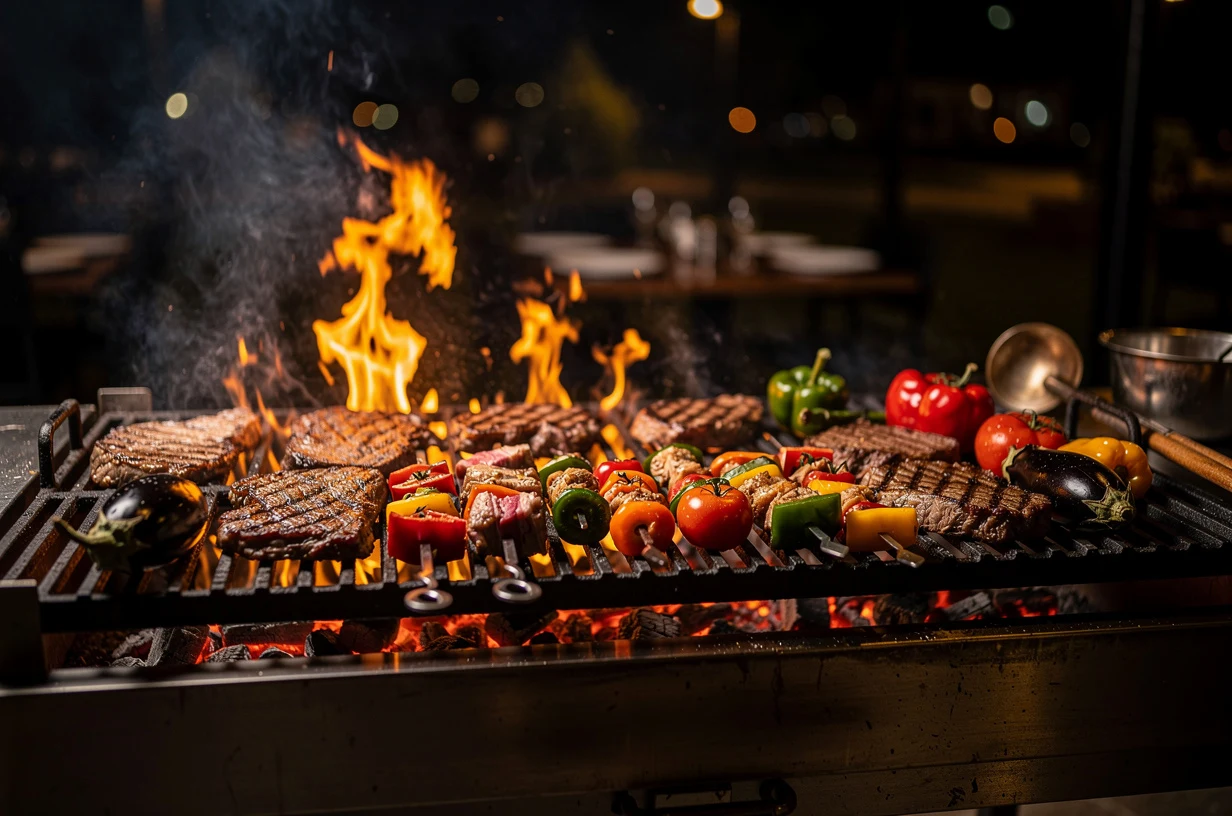
Not fire as a trend or a visual element for Instagram. Fire as a cooking method with its own logic, its own demands, its own particular relationship with ingredients. A 2.5-meter open grill is not a shortcut. It is a commitment to a way of cooking that requires more skill, more attention, and more restraint than a conventional kitchen setup. That was the attraction.
The idea behind Luidze
The concept that became Luidze brought together three things that had been part of my culinary thinking for a long time but had never been in the same room.
The first is Ukrainian hospitality — the understanding that a meal is an event, that people should feel welcomed rather than merely served, that a table is a place where time slows down rather than speeds up. This isn’t about a specific cuisine. It’s an attitude toward guests.
The second is Georgian culinary tradition. Georgia has one of the most distinctive and underrepresented food cultures in the world. It uses fermentation, spice combinations, herb profiles, and slow-cooking techniques that don’t appear elsewhere in quite the same configuration. The approach to meat — particularly lamb — in Georgian cooking has a depth that comes from centuries of specific knowledge. I had been interested in this for years before Luidze existed.
The third is the Spanish Mediterranean context: the fire culture of Andalucía, the quality of local seafood, the produce available on the Costa del Sol, the outdoor character of the region’s hospitality.
Put fire cooking at the center, add Georgian technique and flavoring as the accent layer, and ground it in Mediterranean ingredients and the spirit of Spanish outdoor eating. That is Luidze.
Cortijo Luidze: the name and the place
A cortijo is a traditional Andalusian country estate — a farm complex that typically includes a main house, outbuildings, and land. The word carries associations of space, land, and the old agricultural character of the region. Calling a restaurant a cortijo is a statement about atmosphere and intention: you are not in a city center space, you are somewhere with ground under it.
The location at C. Saladillo, 100 in Estepona reflects this. Estepona is the western end of the Costa del Sol, and it has been growing — new residential developments, a younger demographic of permanent residents, families putting down roots. It has less of the high-season tourist intensity of central Marbella, and more of the character of a place that people actually live in year-round. That suited the kind of restaurant I wanted Luidze to be: a destination you drive to deliberately, not a walk-in from the seafront.
The area around Saladillo also gave us space — physical space — that we couldn’t have found in San Pedro or Marbella at a sensible price. Space to build the grill installation properly. Space for a children’s play area. Space for a terrace that actually breathes.
Fire as the central tool
The grill at Luidze is 2.5 meters wide. This is not an aesthetic choice. It is a functional requirement of the cooking style.
Open fire cooking at a professional level is about heat management across multiple zones at the same time. Different products need different temperatures, different distances from the fire, different timings. You cannot do this well on a narrow grill. The size of the installation determines what is possible in the kitchen, and what is possible in the kitchen determines what ends up on the plate.
Fire changes ingredients in ways that other cooking methods don’t. The Maillard reaction happens differently over open flame than on a flat-top or in an oven. Fat renders and chars in ways that add specific compounds to the flavor. Vegetables — particularly root vegetables and alliums — develop a sweetness against direct heat that can’t be replicated. Seafood, handled properly over fire, has a texture and a finish that is entirely its own.
None of this is mystical. It’s chemistry. But it requires the person managing the grill to understand heat as a dynamic variable rather than a dial setting. Oleksii and the kitchen team spent real time on this before we opened.
The Georgian accent
Georgian cuisine entered Luidze through specific elements rather than as a wholesale adoption of a culinary tradition. We are not a Georgian restaurant. We are a grill restaurant with Georgian flavoring as a distinct and intentional layer.
What Georgian cooking brings to our menu is a set of flavor combinations that are genuinely unfamiliar to most guests on the Costa del Sol and that work particularly well with fire cooking. The use of tarragon in meat preparation — specifically with lamb — comes directly from Georgian tradition, where tkemali (sour plum sauce) and fresh herbs define the profile of slow-cooked meat dishes. Fermentation is another Georgian inheritance: the sour, complex notes that fermentation introduces work as a counterpoint to the char and fat of grilled proteins.
The reason these elements belong in a Mediterranean fire restaurant is that they are not competing with the base — they are deepening it. Fire cooking produces intensity. Georgian-influenced saucing and herb use provides complexity and contrast. The combination is more interesting than either would be alone.
The dishes
Sea bass in kataifi with beurre blanc. Kataifi is a shredded pastry used in both Georgian and broader Caucasian cuisine. Wrapping sea bass in kataifi before cooking over fire creates a crisp, protective layer that insulates the fish while the pastry chars. The beurre blanc cuts through the richness. It’s a dish that demonstrates what happens when the techniques from one tradition solve a problem in another.
Slow-braised lamb with tarragon. The lamb is prepared over time rather than at high heat — a low-and-slow approach that breaks down the connective tissue and allows the tarragon to work into the meat rather than sitting on top of it. The result is nothing like a grilled lamb chop. It’s deeper, more textured, and the herbal note is structural rather than decorative.
Veal with sweet peppers. The fire caramelizes the peppers in a way that amplifies their sweetness, and the veal — cooked to a careful internal temperature over the grill — provides the body that the peppers need. Simple in principle, demanding in execution.
Fermented camembert. This is the dish that generates the most conversation at the table. Fermented camembert has a sourness and complexity that fresh camembert doesn’t. Against fire — served warm, with something acidic and something sweet alongside — it functions as a reminder that dairy products have a whole register of flavor that pasteurization and short production timelines have mostly removed from modern eating.
Oleksii’s role
Brand chef Oleksii Dolbniev built the Luidze menu with me. His path — from Odessa through Norway to Spain — gave him an unusually broad technical vocabulary, and his interest in Georgian culinary tradition was genuine rather than fashionable.
In 2024, Oleksii competed in a televised chef battle against a team from Puerto Banús and won. This mattered to us beyond the obvious satisfaction of winning: it was public confirmation that the cooking we were doing at the Luini group level could hold its own against well-resourced competition in a format where there was nowhere to hide.
The win was covered in local media and added something to the reputation of the group that is harder to build through conventional marketing. People take notice when you win something fairly.
Why a children’s play area is not an afterthought
The children’s area at Luidze was designed into the concept from the beginning, not added as an afterthought because the space allowed it.
The family audience on the Costa del Sol is large and underserved by serious restaurants. Most of the options are either child-tolerant casual dining or fine dining where families feel unwelcome. Luidze is neither. It is a place where the food is genuinely good and the adults can eat without watching the clock while their children are somewhere safe and occupied.
This is also consistent with the Ukrainian understanding of hospitality. The meal is for everyone at the table. A restaurant that works for adults but makes children — and therefore their parents — uncomfortable has solved only half the problem.
What comes next
The goal is 25 restaurants. That sounds like a large number and it is — but the work we have done at Luini and Luidze has been specifically oriented toward building concepts and operational systems that can be replicated with quality rather than despite it. The point is not to grow for the sake of scale. The point is to build something that works and then build it somewhere else without degrading what makes it work.
Luidze, with its open grill and its combination of traditions, is the more complex of the two concepts to replicate. That complexity is worth working through rather than avoiding.
The full case study for Cortijo Luidze — how the concept was developed, how we chose the location, and what the opening looked like — is at /en/cases/cortijo-luidze-concept-and-launch.
If the story of how Luini came before this is relevant to you, it’s at /en/blog/luini-story-of-the-first-restaurant.
And if you are thinking about something similar — a concept that combines culinary traditions rather than staying inside one — I’m available to discuss it at /en/consulting.
